

"Javali has been consistently delivering high-quality web solutions across a number of Givaudan websites. Their in-depth technical knowledge of Drupal is key to ensure we can keep satisfying the requirements of our stakeholders and build best-in-class corporate websites. Their ability to come up with strong technical solutions coupled with their creativity has been the basis of our long-term partnership."
"Javali has been consistently delivering high-quality web solutions across a number of Givaudan websites. Their in-depth technical knowledge of Drupal is key to ensure we can keep satisfying the requirements of our stakeholders and build best-in-class corporate websites. Their ability to come up with strong technical solutions coupled with their creativity has been the basis of our long-term partnership."
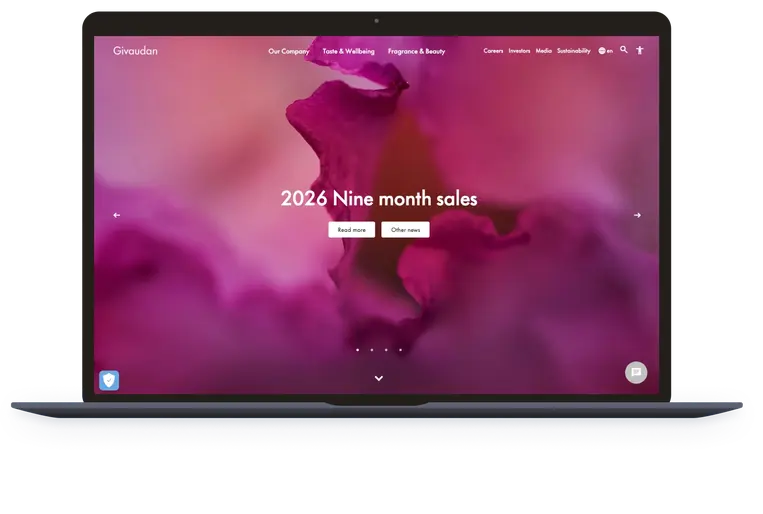
Givaudan is a global leader in the Fragrance & Beauty and Taste & Wellbeing sectors, with an international presence spanning 167 locations and more than 17,500 employees.
This scale also translates into a particularly demanding digital landscape: multiple business areas, diverse audiences, distributed editorial teams, specialized content, and various external systems that need to function as part of a single experience.
JAVALI has been supporting the evolution of Givaudan’s digital platform for several years, ensuring its technological continuity from Drupal 7 through to the current Drupal 11 version.
Throughout this journey, the platform has been progressively transformed to meet new business needs, serve new audiences, and address growing editorial and technological complexity. Microsites have been integrated, new features and external services have become part of the ecosystem, and editorial teams have gained greater autonomy.
More than just supporting an institutional website, the solution serves areas as diverse as corporate communications, sustainability, innovation, careers, investor relations, product discovery, and brand storytelling.
The guiding principle behind the project was simple: complexity should lie in the technology, not in the user experience.
The challenge was not to launch a new website, but to evolve an existing platform without interrupting its operation.
It was necessary to keep it technologically up-to-date, secure, and high-performing while simultaneously and continuously addressing new requirements: consolidating microsites, integrating external systems, increasing content reuse, strengthening governance mechanisms, and giving editorial teams greater autonomy. All of this took place within a global context, involving different business areas, audiences, departments, and editorial responsibilities.
Among the main challenges were:
- Ensuring the platform’s evolution across successive versions of Drupal;
- Maintaining the continuity of a critical platform in production during technological evolution processes;
- Consolidating previously scattered content, microsites, and user experiences;
- Adapting the architecture to new needs without unnecessarily increasing complexity;
- Seamlessly integrating different platforms and external services;
- Create a permissions model suited to Givaudan’s organizational structure;
- Increase editorial autonomy without compromising governance, quality, or brand consistency;
- Ensure high levels of security, accessibility, performance, and maintainability.
The architecture therefore needed to evolve seamlessly: preserve the investment made, meet current needs, and remain prepared for the future.
JAVALI has continuously evolved Givaudan’s Drupal architecture, prioritizing three fundamental principles: reuse, governance, and scalability.
Throughout successive versions of Drupal, the platform has been modernized and reorganized to accommodate new needs, integrate new digital experiences, and reduce fragmentation within the ecosystem.
Today, the solution supports 25 types of structured content, enabling it to meet the needs of different business areas without compromising architectural consistency or the user experience.
A granular permissions model based on profiles, departments, and content categories was also developed. This way, each team accesses and manages only the areas for which it is responsible, while simultaneously enhancing the security and efficiency of editorial processes.
To increase team autonomy, a library of reusable components and a set of specific tools in CKEditor were created. Editors can build pages and rich experiences using predefined components, without relying on technical development for every new requirement.
Drupal also serves as the core of a broader ecosystem of solutions through integrations with platforms such as Coveo, Phenom, OneTrust, UserWay, DeepL, Leaflet, and Brightcove, as well as custom developments tailored to Givaudan’s specific needs.
More than just a series of technological upgrades, this journey demonstrates an approach of continuous platform evolution, in which each new version of Drupal is integrated into a broader strategy of sustainability, improvement, and preparation for new needs.
Givaudan currently operates a global platform built on Drupal 11, which is the result of an ongoing process of technological and functional evolution.
Maintaining and evolving this same platform across several major versions of Drupal has allowed the company to preserve knowledge, investment, and operational continuity, while simultaneously modernizing the architecture and adapting it to business needs.
Key results include:
- Sustained evolution of the platform from Drupal 7 to Drupal 11;
- Consolidation of microsites and digital experiences into a more coherent architecture;
- Greater reuse of content and components;
- Greater autonomy for editorial teams;
- More granular governance tailored to the organization’s structure;
- Integration of multiple external systems and services into a single experience;
- Greater consistency across different areas of the digital ecosystem;
- A modern, secure technology foundation that is ready to continue evolving.
For Givaudan, this represents a platform capable of keeping pace with the organization’s ongoing transformation. For JAVALI, it demonstrates a long-term relationship based on in-depth knowledge of the solution and mastery of the entire lifecycle of an enterprise Drupal platform.
Technologies and features
- A platform launched on Drupal 7 and continuously updated, keeping pace with Drupal’s own evolution, up to version 11;
- A structured architecture with 25 content types;
- Advanced permissions model based on profile, department, and category;
- Library of reusable Drupal components;
- Key integrations include:
- Coveo, for content search and discovery;
- Phenom, for career opportunities;
- OneTrust, for consent management;
- UserWay, to support accessibility needs;
- Leaflet, for interactive mapping experiences;
- Brightcove, for video management and distribution;
- Custom stock quote integration;
- Auto Node Translate and Auto Node Translate DeepL Provider, Drupal contrib modules developed by JAVALI that automate content translation using external services, including the DeepL API;
- Department-specific Instagram feeds;
- A taxonomy-based contact experience that automatically routes each request to the appropriate team.
- Multimedia content optimization;
- Encryption of unpublished content;
- Editorial tools for graphics, tables, datamaps, layouts, multimedia content, questionnaires, and other interactive components.
Contribution to the Drupal community
JAVALI’s approach to Drupal development aims to ensure that solutions created for specific challenges can also generate value for the open-source ecosystem.
In this project, two specific needs led to developments that were later made available as contrib modules.
The logic created to automate multilingual content translation processes evolved into Auto Node Translate, allowing this approach to be reused in other Drupal projects.
Similarly, a solution initially created for managing validation and consent evolved into the Consent Popup module, which can be reused in various consent and age-gating scenarios.
This ability to transform specific development into reusable solutions reflects an important part of JAVALI’s technical approach: solving each project’s problem without losing sight of sustainability, reusability, and value for the Drupal community.


