
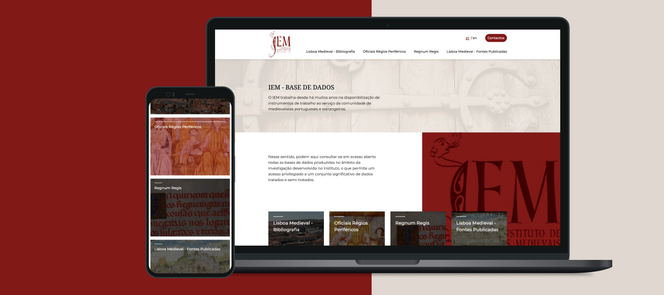
The Institute for Medieval Studies (IEM), part of the Faculty of Social and Human Sciences of the Universidade Nova de Lisboa, has launched its new digital platform dedicated to the public dissemination of historical research databases.
The project, developed by JAVALI using Drupal 10, completely modernises the previous portal, ensuring greater accessibility, stability, and ease of use.
With a rich and highly specialised collection, IEM now provides open and free access to four fundamental databases for the study of Medieval Lisbon and the Portuguese royal administration. The new platform offers clearer navigation, advanced filters, and optimised performance, enabling more efficient exploration of content by researchers, students, and the general public.
The technological upgrade included the full migration of existing data, the implementation of a simplified back office, preparation of the platform for PT/EN, and the creation of a modular structure that will allow future expansion with new features and documentary collections.
The result is a modern, responsive digital solution designed to grow in tandem with academic research, reinforcing IEM’s commitment to open access to knowledge.
In an official statement, the IEM team said: “The work carried out in partnership with Javali proved to be a decisive asset in ensuring the curation and open, free access to databases containing relevant information on the medieval period. The company’s technical competence and flexibility, combined with its ability to listen to the specific needs and challenges of medieval studies research, made it possible to implement robust, sustainable, and interoperable digital solutions, ensuring data integrity and long-term access. Thanks to this collaboration, it is now possible to continue disseminating, promoting, and sharing the knowledge produced by IEM and its researchers with academic circles and the wider community, thereby fostering greater inclusion in scientific knowledge.”